
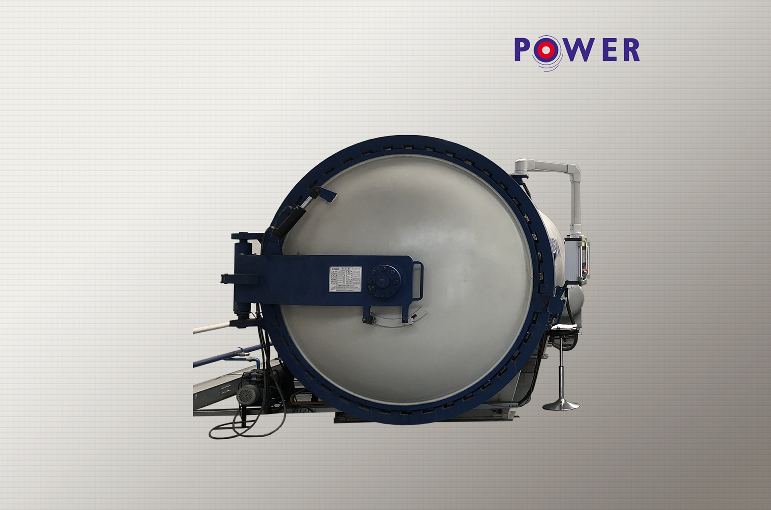
A vulcanizing autoclave, often simply called a rubber autoclave, is a pressure vessel designed specifically for the vulcanization process of rubber and other polymer-based materials. Vulcanization, discovered by Charles Goodyear in 1839, is a chemical process that converts natural rubber or other elastomers into a more durable, elastic, and heat-resistant material by cross-linking the polymer chains with sulfur or other curatives. The autoclave provides the essential environment of controlled heat, pressure, and often time to facilitate this transformation. This article discusses the key applications, classification methods, and fundamental working principle of vulcanizing autoclaves.
Applications
Vulcanizing autoclaves are indispensable across numerous industries due to their ability to cure rubber components of various sizes and geometries uniformly. The primary applications include:
1. Tire Manufacturing and Retreading: One of the most common uses is curing new tires and retreading worn ones. The autoclave applies heat and pressure to bond the new tread rubber to the tire casing, ensuring structural integrity and roadworthiness.
2. Rubber Rollers and Linings: Industrial rubber rollers used in printing, textile, and paper mills, as well as rubber linings for chemical tanks and pipes, are cured in autoclaves to achieve uniform hardness and chemical resistance.
3. Hose and Conveyor Belts: Long, continuous rubber products like hydraulic hoses and conveyor belts are often vulcanized in horizontal autoclaves. The pressure ensures the rubber is compacted without voids, enhancing durability.
4. Shoe Soles and Footwear: Many rubber outsoles and protective footwear components are cured in autoclaves to achieve precise elasticity and abrasion resistance.
5. Silicone and Speciality Products: Silicone rubber used for medical implants, kitchenware, and automotive seals also requires autoclave curing to achieve cross-linking, often using peroxide or platinum catalysts instead of sulfur.
6. Composites and Laminates: Beyond rubber, autoclaves are used to cure advanced composite materials (e.g., carbon fiber reinforced polymers) where high pressure and temperature eliminate voids and ensure proper consolidation.
Classification
Vulcanizing autoclaves can be classified based on several criteria:
1. By Heating Method:
· Steam-Heated Autoclave: The most traditional type. Saturated steam is directly introduced into the vessel, providing excellent heat transfer and a moist environment. It is economical for large-scale rubber curing.
· Electric-Heated Autoclave: Electrical heating elements are mounted inside or on the walls. Hot air is circulated by fans. This method offers precise temperature control and avoids boiler installation, ideal for smaller batches or where steam is unavailable.
· Hot Oil (Indirect) Heating: Thermal oil is heated externally and circulated through coils inside the autoclave. This provides uniform, stable temperatures without steam pressure hazards.
2. By Orientation:
· Horizontal Autoclave: The most common configuration, where the vessel lies horizontally. It is suitable for long products (hoses, belts) and easy loading/unloading via a track-mounted cart.
· Vertical Autoclave: Cylindrical vessel standing upright. It occupies less floor space and is used for tall, slender components or where gravity assists loading, but it is less common for general rubber curing.
3. By Operation Mode:
· Manual Autoclave: Pressure, temperature, and cycle time are controlled manually by operators using valves and gauges. Suitable for small workshops but less precise.
· Semi-Automatic Autoclave: Equipped with programmable logic controllers (PLC) and sensors; operators initiate cycles, but the autoclave automatically follows preset parameters.
· Fully Automatic Autoclave: Computer-controlled with data logging, remote monitoring, and integration with production lines. It ensures repeatability, safety, and efficiency for mass production.
4. By Structure:
· Single-Wall Autoclave: The vessel wall is a single steel layer; external insulation is added. Simple and low-cost.
· Double-Wall Autoclave: A steam jacket surrounds the inner vessel for indirect heating, providing more uniform temperature and faster warm-up.
Working Principle
The working principle of a vulcanizing autoclave revolves around creating a controlled environment that promotes the sulfur cross-linking reaction while preventing defects such as porosity or blistering.
Step 1: Loading and Sealing
The uncured rubber product (green rubber) is placed on a cart or rack and rolled into the autoclave chamber. The lid is then closed and sealed using a quick-opening closure mechanism (e.g., bayonet or hinged bolts) to withstand internal pressure.
Step 2: Heating and Pressurization
The control system activates the heating source. In a steam autoclave, saturated steam from a boiler enters the vessel. As steam condenses on the cooler rubber surface, it releases latent heat, rapidly raising the temperature of the compound. Simultaneously, the pressure rises. Typical curing conditions range from 120°C to 200°C (250°F to 390°F) and pressures from 0.4 MPa to 2.0 MPa (60 to 290 psi). For electric autoclaves, heated air is circulated by fans to avoid temperature stratification.
Step 3: Vulcanization Reaction
The combination of heat and pressure accomplishes two things:
· Heat activates the sulfur or other cross-linking agents, causing them to form covalent bonds between adjacent polymer chains. This transforms the plastic-like raw rubber into an elastic, strong network.
· Pressure prevents the formation of bubbles from volatile compounds or trapped air. It also forces the rubber into intimate contact with any fabric or metal reinforcement, ensuring adhesion.
Step 4: Holding and Curing
The autoclave maintains the set temperature and pressure for a specific duration (curing time), determined by the thickness and compound formulation of the part. During this period, cross-linking proceeds to the desired level. Modern autoclaves monitor internal temperature via multiple sensors to ensure uniformity—variations can lead to under-cured (soft, sticky) or over-cured (brittle, charred) products.
Step 5: Cooling and Depressurization
After curing, the heat source is turned off. In many designs, cooling water is sprayed into the chamber or cooling coils are activated. The pressure is gradually released to avoid sudden stress on the rubber, which could cause “explosive decompression” cracks. Once the temperature and pressure return to safe levels, the lid is opened, and the finished product is removed.
Safety Considerations
Because autoclaves operate under high pressure and temperature, they are equipped with multiple safety features: pressure relief valves, burst discs, interlocking lid systems (prevents opening under pressure), and automated emergency shutdowns. Regular inspection and hydrostatic testing are mandatory to prevent catastrophic failures.
In summary, the vulcanizing autoclave is a critical industrial tool that enables the production of high-quality rubber goods by precisely controlling the heat and pressure environment required for cross-linking. Its versatile classifications—by heating method, orientation, and automation—allow it to serve diverse applications from tire retreading to advanced composite manufacturing. Understanding its working principle ensures optimal product quality and operational safety.
Post time: May-26-2026