
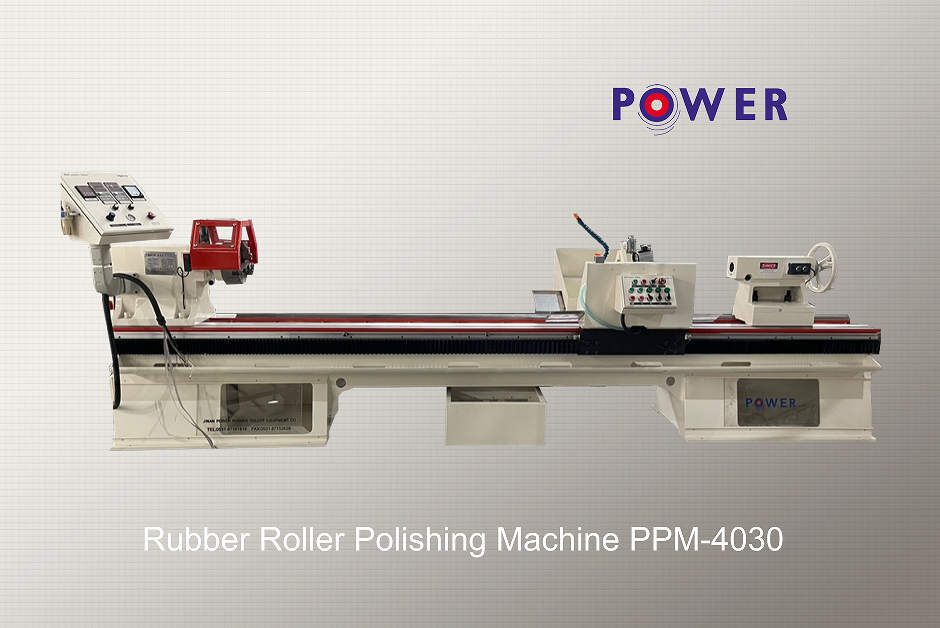
In the diverse landscape of industrial manufacturing, the rubber roller is a ubiquitous yet critical component. Found in everything from high-speed printing presses and laminating machines to steel processing lines and office copiers, the performance of a rubber roller is almost entirely dictated by the quality of its surface. While a roller may be shaped and covered with precision, china roller processing manufacturer,it is the final stage of finishing—specifically, polishing—that elevates a functional component into a high-precision tool. The rubber roller polishing machine is the specialized equipment designed for this definitive task, rubber roller manufacturer,employed when the standard of surface roughness (Ra) demands near-perfect smoothness.
The Objective: Surface Roughness and Its Implications
Surface roughness is not merely an aesthetic metric; it is a functional specification that governs how a roller interacts with its environment. In applications such as medical device manufacturing, optical film production, or high-end printing, even microscopic imperfections on a roller’s surface can translate into catastrophic defects.
When specifications call for surface roughness values below 0.2 Ra (micrometers) or even into the sub-micron range, standard grinding is insufficient. Grinding leaves a directional, matte finish characterized by microscopic peaks and valleys. The polishing machine is utilized to flatten these peaks, creating a surface that is not only smoother but also more chemically inert and resistant to material adhesion. For rollers used in silicone or urethane applications—where stickiness can cause web breaks in printing or wrapping—the polished surface ensures clean release and consistent tension.
The Mechanism: From Abrasive Cutting to Surface Burnishing
The rubber roller polishing machine differs fundamentally from a standard cylindrical grinder. While a grinder uses a rigid, high-speed grinding wheel to remove material and achieve dimensional accuracy, the polishing machine operates on a principle of controlled friction and fine abrasion.
Modern polishing machines typically consist of a heavy-duty lathe bed with a precision headstock and tailstock to support the roller. The critical component is the polishing arm or carriage, which holds abrasive media. Unlike grinding, where the wheel is harder than the workpiece, polishing rubber requires a careful balance of speed, pressure, and abrasive grit.
The process usually progresses through multiple stages:
1. Pre-Polishing (Smoothing): Starting with medium-grit abrasive belts or stones (typically 400 to 800 grit) to remove the spiral marks left by the grinding process. This stage ensures geometric consistency.
2. Fine Polishing: Transitioning to high-grit abrasive films (1500 to 3000 grit) or non-woven nylon abrasives impregnated with fine particles. fine polishing machine,At this stage, the machine reduces the Ra value significantly, moving toward a semi-gloss finish.
3. Ultra-Finishing (Burnishing): For the highest requirements (optical clarity or sub-1 Ra values), the machine may utilize specialized polishing cloths or felt wicks charged with ultra-fine diamond paste or liquid compounds. At this stage, the process is less about material removal and more about “smearing” the rubber surface to close microscopic pores and eliminate the directional texture entirely.
Modern machines incorporate features such as oscillating abrasive heads to prevent the formation of concentric rings, variable speed drives to control surface feet per minute (SFM), and automated pressure sensors to ensure consistent contact across the length of the roller face.
The Role in Finishing
In the hierarchy of roller manufacturing, polishing represents the final quality gate. After a roller is cast, vulcanized (for rubber), or cured (for polyurethane), it undergoes rough turning and then precision grinding to bring it to the correct diameter and taper tolerance. However, grinding often work-hardens the rubber surface or creates a “chatter” pattern.
The polishing machine serves three critical finishing functions:
· Decoupling Geometry from Texture: While the grinder dictates the roundness and diameter, the polisher dictates the texture without altering the geometry.
· Edge Honing: For rollers with undercuts or grooves, polishing machines equipped with contouring capabilities can polish the faces and edges to prevent sharp burrs that could damage sensitive webs or films.
· Material Compatibility: Different elastomers react differently to heat. Polishing machines run at lower surface speeds with cooling mechanisms (air or liquid coolant) to prevent the heat generated by friction from swelling the rubber or breaking down polyurethane binders.
Machine Configurations and Automation
The complexity of a rubber roller polishing machine varies by application.
· Manual Lathe-Based Polishers: Common in small shops or repair facilities, these rely on the operator’s skill to apply abrasive belts manually against a rotating roller. While cost-effective, they are inconsistent for high-precision work.
· CNC Polishing Centers: For high-volume or high-precision manufacturing, CNC (Computer Numerical Control) polishing centers are the standard. These machines store finishing recipes, automatically change abrasive grits, and maintain linear pressure across the roller’s crown. They are essential for rollers with complex profiles (crowned, concave, or stepped) where manual polishing would distort the engineered shape.
· Superfinishing Attachments: Some operations utilize superfinishing heads that combine oscillation with high-pressure coolant to achieve a “cross-hatch” pattern, though for pure mirror finishes on rubber, the felt-and-paste method remains the gold standard.
Advantages and Limitations
The primary advantage of using a dedicated polishing machine is the achievement of a defect-free, mirror-like surface that minimizes friction and maximizes release properties. For industries like flexographic printing, a polished roller ensures precise ink transfer; for laminating, it prevents the accumulation of adhesive residue.
However, limitations exist. Polishing is a subtractive process that removes a small amount of material. If the rubber covering is too thin, or if the operator polishes aggressively to remove a deep defect, the roller’s diameter may fall out of tolerance. Furthermore, not all rubber compounds polish equally. Soft durometer rollers (below 40 Shore A) are notoriously difficult to polish, rubber processing,as they tend to “bunch up” under the abrasive pressure, whereas harder urethanes and EPDM compounds can achieve glass-like finishes.
Conclusion
The rubber roller polishing machine is far more than a simple finishing tool; it is the bridge between mechanical precision and functional performance. In an era where manufacturing tolerances are shrinking and quality demands are rising—particularly in the electronics, medical, and packaging sectors—the ability to control surface roughness at the micro-level is a decisive competitive advantage.
By combining advanced abrasive technology with precise mechanical control, these machines ensure that a rubber roller does not merely meet its diameter specification, but performs flawlessly under the demanding conditions of high-speed, high-stakes industrial production. Whether it is a steel mill roller requiring corrosion-resistant smoothness or a printer’s roller demanding flawless ink distribution, the polishing machine provides the final, critical touch of perfection.
Post time: Mar-24-2026