
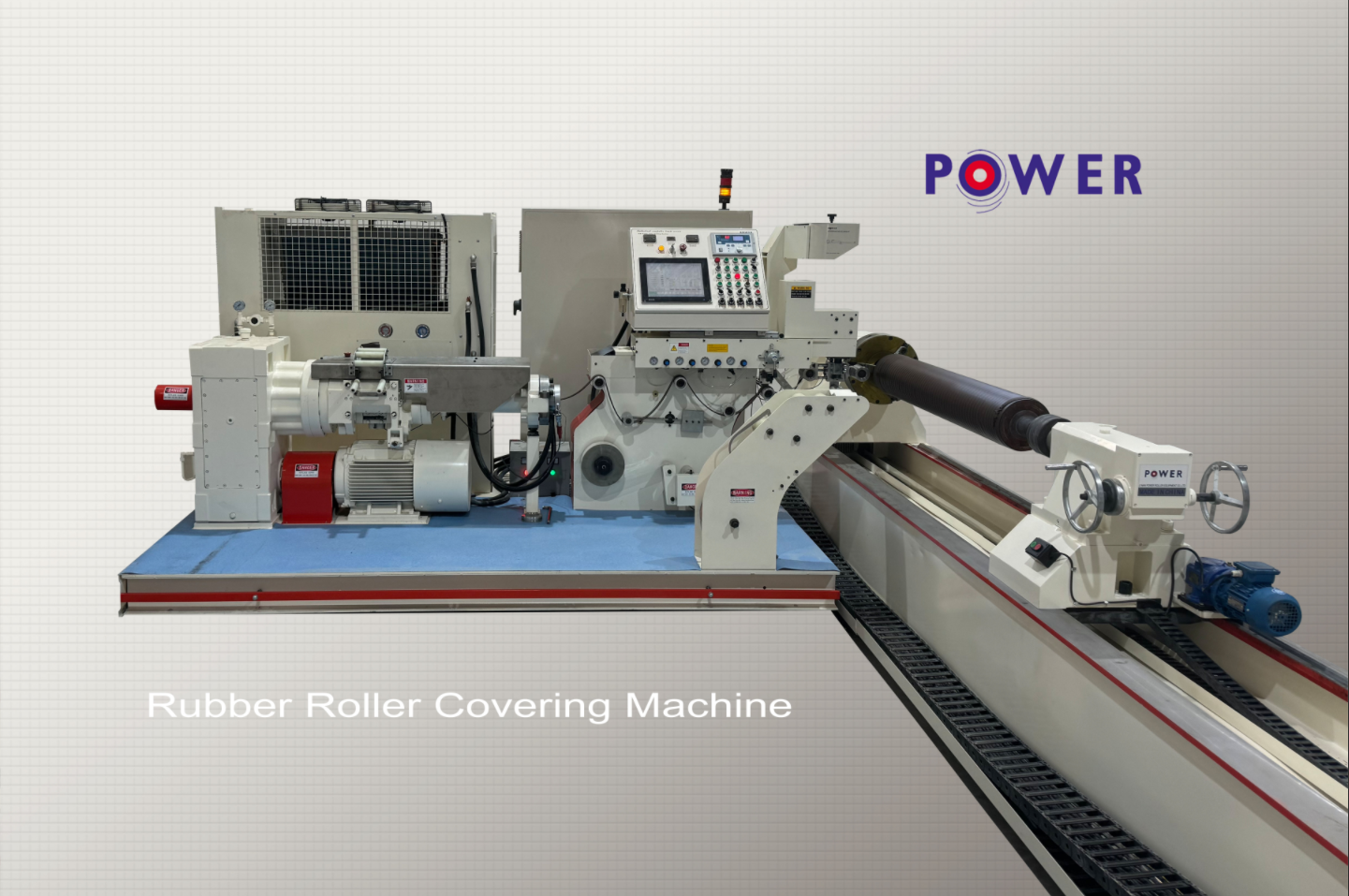
Rubber rollers are critical components in industries ranging from papermaking and printing to textiles and steel processing. Their performance—surface hardness, dimensional accuracy, and chemical resistance—depends entirely on a meticulously controlled manufacturing process. Producing a high-quality rubber roller involves transforming a bare metal core and uncured rubber compound into a precision-engineered elastomeric covering. This article outlines the step-by-step manufacturing process, the equipment used at each stage, and the quality checks involved.
1. Core Preparation (Metal Shaft Machining)
Every rubber roller starts with a metal core, typically made of steel, stainless steel, or aluminum. The core must provide structural rigidity and a reliable bond with the rubber.
Process:
· The metal shaft is cleaned of rust, oil, and old rubber (if reconditioning).
· The bonding surface is roughened via sandblasting or shot blasting to create a mechanical key.
· A primer and a specialized adhesive (e.g., a chemosil system) are applied to the prepared surface to promote chemical bonding between metal and rubber.
Equipment used:
· Lathe or grinding machine – to true the shaft and achieve the correct diameter.
· Sandblasting cabinet – for surface roughening (using aluminum oxide or steel grit).
· Spray gun or dip coating station – for applying primer and adhesive layers.
2. Rubber Compound Mixing
The rubber cover is not a single material but a formulated compound. Depending on the application, base polymers include natural rubber (NR), nitrile rubber (NBR), EPDM, neoprene, or polyurethane. Fillers (carbon black, silica), plasticizers, vulcanizing agents (sulfur or peroxides), and antioxidants are added.
Process:
· Raw polymers are masticated to break down molecular chains.
· Fillers and additives are blended in a controlled sequence to achieve uniform dispersion.
Equipment used:
· Two-roll mill – for masticating and mixing small batches; two counter-rotating rollers shear and blend the ingredients.
· Internal mixer (Banbury mixer) – for large-scale, high-shear mixing with temperature control.
· Cooling conveyor – to cool the mixed compound before storage or calendering.
3. Applying the Rubber to the Core
There are three common methods for applying the uncured rubber onto the prepared metal core: extrusion molding, compression molding, and the calendering/wrapping method. The most widely used for precision rollers is the strip-winding (or calendering) method.
Strip-Winding Process:
· A warm, softened rubber compound is fed into a calender or a roller head extruder to produce a continuous, uniform-thickness strip.
· The strip is spirally wound onto the rotating core under controlled tension and pressure, ensuring no air is trapped between layers.
Alternative – Compression Molding (for small or complex shapes):
· The core is placed inside a split mold cavity, and uncured rubber is injected or pressed around it.
Equipment used:
· Calender – a three- or four-roll machine that produces smooth rubber sheets/strips.
· Strip-winding machine – a lathe-like device with a carriage that guides the rubber strip onto the core while the core rotates.
· Hydraulic mold press (for compression molding) – capable of 100–300 tons of clamping force.
4. Vulcanization (Curing)
Vulcanization is the chemical process that cross-links rubber molecules, transforming the soft, tacky compound into a strong, resilient elastomer. Heat and pressure are applied for a specific time and temperature profile.
Process:
· The wound rubber-covered core is wrapped tightly with a shrinkable tape (e.g., nylon or polypropylene) to apply radial pressure during curing.
· The assembly is placed in an autoclave or vulcanizer and heated to typically 140–160°C for 2–6 hours.
· For polyurethane rollers, casting and oven curing are used instead of sulfur vulcanization.
Equipment used:
· (vulcanizer) – a pressure vessel capable of 5–10 bar steam or hot air circulation; many are horizontal with rails to load long rollers.
· Electric oven – for smaller or polyurethane rollers where pressure is applied by external wrapping.
· Temperature recorder – to log the curing cycle and ensure uniformity.
5. Grinding and Surface Finishing
After curing, the rubber cover is rough, may have tape marks, and is not concentric. Precision grinding gives the roller its final diameter, surface finish, and runout tolerance (typically ≤0.05 mm TIR).
Process:
· The cured roller is mounted between centers on a grinding lathe.
· A rotating abrasive wheel (aluminum oxide or silicon carbide) traverses across the roller while it spins, removing material to the target diameter.
· For grooved rollers (e.g., press rolls in paper machines), a special grooving lathe or CNC mill cuts helical or circumferential grooves after grinding.
· Final polishing with fine-grit abrasive belts achieves the required surface roughness (e.g., 0.4–0.8 µm Ra).
Equipment used:
· Rubber roller grinding machine (external cylindrical grinder) – equipped with a traversing grinding head and variable spindle speed. Often includes a dust extraction system to remove rubber dust.
· Grooving lathe / CNC grooving machine – with diamond or carbide cutting tools for press roll grooves.
· Hardness tester (Shore A/D durometer) – mounted on a stand to measure surface hardness at multiple points.
· Balancing machine – dynamic balancer to correct any rotational imbalance.
6. Final Inspection and Packaging
Every roller must be verified against customer specifications before shipment.
Inspection parameters:
· Visual check for blisters, pinholes, or foreign inclusions.
· Dimensional measurement (diameter, length, TIR) using laser micrometers or dial indicators.
· Hardness profile across the face.
· For press rolls, groove depth and spacing accuracy.
Equipment used:
· Coordinate measuring machine (CMM) or digital vernier calipers.
· Surface roughness tester.
· Roller runout test stand with dial indicators.
· Packaging station – bubble wrap, wooden cradles, and moisture barrier bags to protect the finished roller during storage or shipping.
Conclusion
Manufacturing a rubber roller is a multi-stage process that demands precision at every step. From core preparation and compound mixing to strip winding, vulcanization, and final grinding, each phase relies on specialized equipment—sandblasters, calenders, autoclaves, and cylindrical grinders—to achieve the required mechanical properties and dimensional accuracy. A well-made rubber roller will deliver consistent nip pressure, chemical resistance, and long service life. Conversely, any deviation in curing temperature or grinding tolerance can lead to premature failure. Understanding this process helps engineers and maintenance teams appreciate the complexity behind these seemingly simple components and underscores the importance of specifying the right manufacturing quality for demanding applications.
Post time: Apr-29-2026