
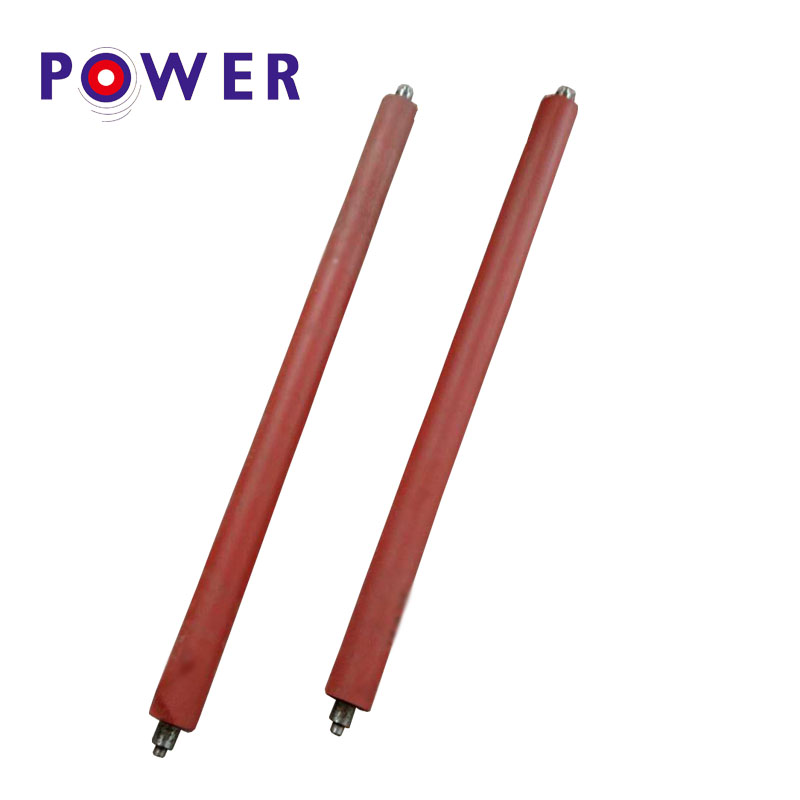
Rubber Rollers in the Paper Industry: Applications, Operational Use, and Maintenance Practices
Introduction
In the modern papermaking industry, precision and reliability are paramount. From the pulp preparation stage to the final winding of the finished reel, every process depends on consistent pressure, efficient water removal, and smooth sheet transport. Rubber rollers—cylindrical components with a metal core covered by an elastomeric layer—are indispensable in achieving these goals. Their resilience, chemical resistance, and ability to provide uniform nip pressure make them critical assets. However, their performance and lifespan depend heavily on correct usage and systematic maintenance. This article explores the applications of rubber rollers in paper machines, supply china long rubber strip feeder,explains their correct operational use, and provides a detailed guide to proper maintenance.
Applications of Rubber Rollers in Papermaking
Rubber rollers are found throughout paper machine sections, each with a specific formulation to suit the operating environment.
1. Forming Section: In the wire part, rubber roller supplier,rubber-covered breast rolls and deflector rolls support the forming fabric and help dewater the stock. These rollers require good wear resistance and a smooth surface to avoid marking the wet web.
2. Press Section: This is the most demanding application. Press rolls, such as suction press rolls and grooved press rolls, remove mechanical water from the wet paper web. The rubber covers on these rolls are typically made of natural rubber or polyurethane, offering high compression strength and excellent rebound. The grooved or drilled surfaces allow water to escape rapidly, increasing dry solids content before the drying section.
3. Size Press & Coater Rolls: Surface sizing and coating add functional properties to paper. Applicator rolls and metering rolls transfer starch, pigment, or other chemicals onto the paper surface. Here, rubber compounds must resist chemicals, abrasion from coating slurries, and possess a fine, uniform finish to ensure coat weight consistency.
4. Calender Stack Rolls: For some soft calendering applications, rubber rollers working against heated steel rolls improve paper smoothness and gloss without excessively reducing bulk. These require excellent heat resistance and stable hardness.
5. Winding & Rewinding Rolls: At the dry end, rubber-covered carrier rolls and slitter rewind rolls guide the finished paper into reels. They must provide good traction, prevent telescoping, and avoid crush marks on the roll edges.
How to Use Rubber Rollers Correctly
Proper usage extends the life of a rubber roller and maintains paper quality. The following practices should be followed:
· Matching Roll Hardness to Application: Selecting the correct Shore A hardness (e.g., 80–95 for press rolls, 20–40 for soft calenders) is essential. Too hard a roller may cause crushing or marking; too soft may lead to excessive deflection and uneven pressure.
· Setting Uniform Nip Pressure: The nip pressure between two counter-rotating rolls must be uniform across the machine width. Operators should use a nip impression test (using carbon paper and a white sheet) to check for even loading. Adjust crown or loading mechanisms if the nip appears heavy on one side.
· Controlling Temperature and Chemical Compatibility: Rubber rollers have maximum operating temperature limits (e.g., 80–100°C for polyurethane). Exceeding this accelerates aging. Also, ensure that cleaning agents, sizing chemicals, or solvents do not attack the rubber compound. Consult the roller manufacturer’s compatibility chart.
· Safe Startup and Shutdown: Before starting a paper machine, ensure the felt or fabric is properly tensioned and the rollers are not in a static “flat-spotted” condition. After a prolonged shutdown, rotate the rollers manually or at slow speed to warm them gradually, preventing thermal shock and surface cracks.
· Avoiding Foreign Object Damage: Sharp objects (e.g., scrapers, wire fragments) can gouge rubber surfaces. Always inspect the paper web for debris and maintain proper clearance of doctor blades.
How to Maintain Rubber Rollers
Systematic maintenance is the key to maximizing roller life, often extending it from 12 to 36 months of continuous operation.
Daily/Shift-Based Maintenance:
· Visual Inspection: Check for visible cuts, blisters, cracks, or localized wear. Any surface defect that exceeds 1 mm in depth should be noted for monitoring.
· Surface Cleaning: Contaminants like pitch, stickies, or coating residue build up on the roller surface, causing poor release and vibration. Use a light spray of clean water or a recommended rubber-safe cleaner while rotating the roll, then wipe with a soft felt or brush. Never use metal scrapers directly on the rubber.
· Doctor Blade Condition: Ensure doctor blades are sharp, correctly angled (typically 15–20°), manufacturers supply china long rubber strip feeder,and not wearing into the rubber. Replace worn or nicked blades immediately.
Weekly/Monthly Maintenance:
· Hardness Check: Measure the rubber surface hardness at several points across the face. An increase of more than 5 Shore A points indicates aging or heat hardening; a decrease suggests softening by oil or chemicals.
· Runout and Vibration Measurement: Use a dial indicator to check for concentricity. Excessive total indicator runout (TIR) (>0.1 mm) or vibration signals bearing issues or uneven swelling, which will damage paper quality.
· Lubrication of Bearings: Follow the manufacturer’s schedule. Over-greasing can force grease past seals onto the rubber, causing swelling. Under-greasing leads to bearing failure and eventual roller damage.
Long-Term Maintenance:
· Periodical Regrinding: After 6–12 months of service, the roller surface becomes glazed or wear-patterned. Regrinding restores the correct profile, surface finish (typically 0.4–0.8 µm Ra), and removes micro-cracks. For grooved press rolls, also re-cut the grooves.
· Storage of Spare Rollers: Store spare rubber rollers horizontally on properly supported cradles in a cool, dry, dark room (15–25°C, <60% humidity). Avoid direct sunlight, ozone from electric motors, and contact with solvents. Wrap the rubber surface in opaque polyethylene or a breathable cloth. Rotate the stored roll 90° every month to prevent compression set.
· Replacement Criteria: Replace a rubber roller when: (a) the rubber has worn down to 5–10% of its original thickness, (b) deep cracks or a loose bond at the metal core are detected, or (c) hardness has changed beyond permissible limits, causing quality defects.
Conclusion
Rubber rollers are not merely passive components; they are active tools that control water removal, pressure distribution, and sheet finish in papermaking. Understanding their specific applications—from the press to the reel—is the first step. Correct usage, including proper nip setting, chemical compatibility, and clean operation, ensures they perform as designed. Finally, a disciplined maintenance regime—covering daily cleaning, hardness checks, periodic regrinding, and correct storage—can double the service life of these expensive consumables. By respecting the material properties of rubber and applying systematic care, paper mills can reduce downtime, lower operating costs, and produce consistently high-quality paper.
Post time: Apr-29-2026