
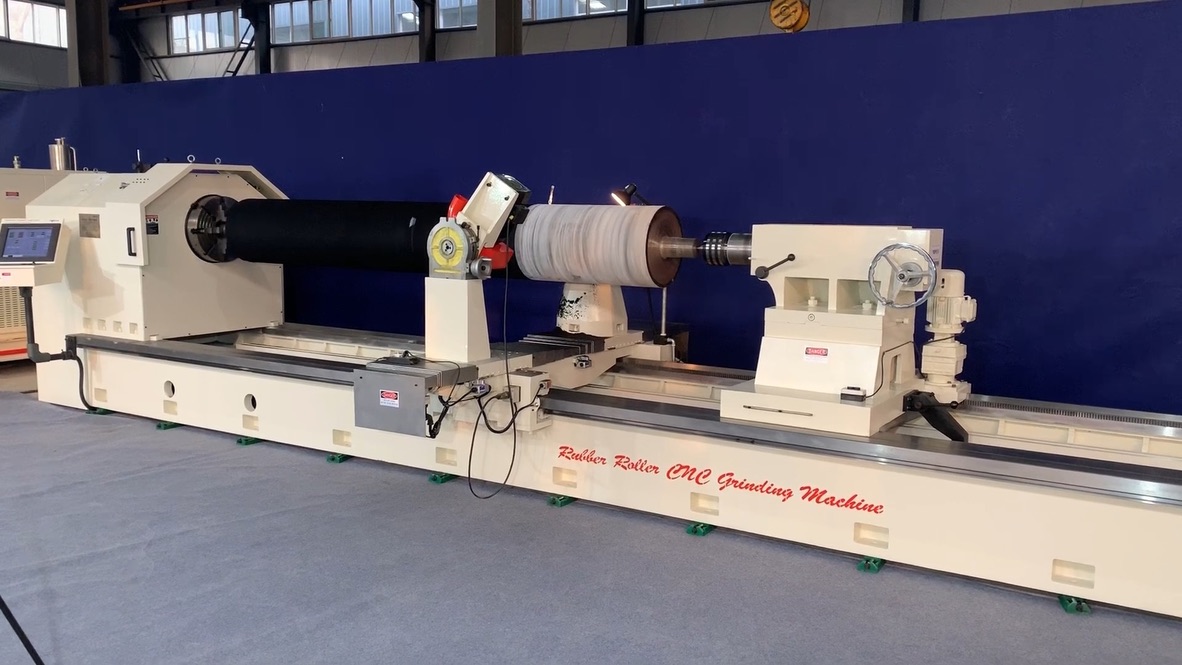
Rubber rollers are essential components in printing, packaging, paper converting, textile, film, coating, laminating, and many other industries. Their performance depends on diameter accuracy, concentricity, roundness, crown profile, and surface finish. A rubber roller turning and grinding machine is a specialized CNC machine built to manufacture and recondition rubber-covered rollers. By combining turning and grinding in one platform, it delivers accuracy, efficiency, and flexibility for both new production and repair work.
Key Functions
1. Turning and roughing. The machine removes worn rubber, old covering, surface damage, and excess material. A sharp tool or insert turns the roller to a preliminary diameter, correcting eccentricity and preparing the surface for grinding. This step is especially important when restoring used rollers that have flat spots, grooves, or uneven wear.
2. Precision grinding. After turning, the grinding head finishes the rubber surface to the required diameter and surface roughness. The grinding wheel can traverse along the roller or plunge-cut into it, depending on the profile and material. This produces a smooth, uniform surface that supports consistent nip pressure and web handling.
3. Crowning and taper grinding. Many rollers require a convex or concave crown, taper, or end relief to compensate for deflection under load. The CNC system generates these profiles accurately,china grinding equipment, ensuring uniform contact across the roller face. This is critical in printing, coating, and laminating, where an uneven nip can cause defects.
4. Grooving, threading, and texturing. The machine can cut spiral grooves, chevron patterns, axial grooves, and other surface textures. These features improve grip, control fluid transfer, reduce air entrapment, or provide metering action. Textured rollers are widely used in coating, embossing, and conveying applications.
5. End face and shoulder machining. It machines roller ends, shoulders, chamfers, and radii to precise dimensions. This ensures proper fit in bearings, chucks, and machine frames, reducing vibration and alignment problems.
6. CNC control and profile generation. Modern machines use CNC controllers to store recipes, interpolate profiles, compensate for wheel wear, and repeat complex cycles automatically. Operators can switch between roller sizes and profiles with minimal setup, improving productivity and consistency.
7. Workholding and support. Headstock, tailstock, steady rests, centers, and chucks hold the roller securely. Proper support prevents deflection and vibration, which is essential when machining long, heavy, or flexible rubber rollers.
8. Measurement and compensation. Some machines include laser or contact measuring systems that check diameter, roundness, taper, and crown during or after machining. The CNC system can automatically adjust the cutting or grinding cycle to meet tolerances.
9. Dust extraction and cooling. Rubber grinding generates dust, fumes, and heat. Enclosed guarding, vacuum extraction, mist collection, and coolant systems keep the work area clean, protect operators, and prevent surface damage.
10. Automation. Automatic cycles, tool changers, wheel dressing, and load/unload options reduce manual intervention. This leads to shorter cycle times and more stable quality in high-volume production.
Major Advantages
The greatest advantage of a rubber roller turning and grinding machine is one-setup processing. Turning and grinding occur on the same machine without removing the roller. This reduces handling, saves time, and improves concentricity between the journal and the rubber surface. The result is a roller that runs truer at high speed.
High accuracy and repeatability are also key benefits. CNC control, rigid construction, and precise feedback systems allow tight tolerances on diameter, roundness, cylindricity, and crown. Once a program is proven, every roller in the batch can be produced to the same specification, reducing dependence on operator skill.
Superior surface finish improves roller performance. A smooth, uniform rubber surface provides consistent nip pressure, reduces marking, and prevents web slippage. In printing and coating, this means better print quality, fewer defects, and higher production yields.
Versatility is another strong point. The machine can handle different rubber compounds, china grinding machinery market by material,hardness levels, and roller sizes, cnc cylindrical grinder machine,from small industrial rollers to large paper mill rollers. It can produce plain, crowned, tapered, grooved, and textured surfaces, making it suitable for many industries.
Productivity and cost savings follow naturally. Fast roughing, precision finishing, automatic cycles, grinding machine manufacturers,and reduced handling shorten production time. Less scrap and rework lower material waste. Reconditioning worn rollers instead of buying new ones extends service life and reduces replacement costs. Reduced downtime also improves overall plant efficiency.
Safety and environmental benefits are significant. Enclosed machining zones, interlocks, dust extraction, and proper guarding protect operators from rotating parts, rubber dust, and airborne particles. Cleaner working conditions also support better maintenance and compliance.
Improved roller performance is the final and most important advantage. Accurate geometry, balanced rotation, correct crown, and the right surface texture lead to smoother web transport, less vibration, longer bearing life, and better product quality. For industries that depend on rollers, this directly affects productivity and profitability.
In conclusion, a rubber roller turning and grinding machine is more than a lathe or grinder. It is a complete solution for manufacturing and restoring precision rubber rollers. Its functions cover turning, grinding, crowning, grooving, texturing, measurement, and automation. Its advantages include accuracy, repeatability, versatility, efficiency, safety, and cost reduction. As modern industry demands tighter tolerances and better surface quality, this machine remains an essential tool for roller producers and maintenance workshops.
Post time: Oct-13-2026