
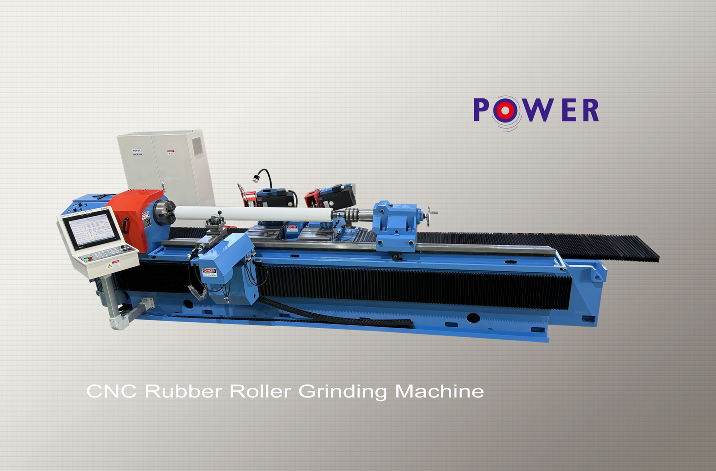
Rubber rollers are deceptively simple components, yet their performance determines the quality of products ranging from newspapers and flexible packaging to textiles and lithium-ion battery electrodes. In industries where a micron of deviation can cause defects, the CNC rubber roller turning and grinding machine has become the defining tool for manufacturing and refurbishing these critical cylinders.cylindrical grinding machine manufacturers, By combining turning and grinding in a single platform under computer numerical control, grinding machine exporters,these machines address the fundamental challenge of processing soft, viscoelastic rubber without sacrificing dimensional accuracy or surface integrity.
The Core Advantage: Integration and Rigidity
The most significant evolution in this field is the shift from separate turning and grinding operations to integrated turning–grinding architectures. Traditional workflows require multiple setups, and each reclamping introduces the risk of misalignment—a critical concern when working with rubber, which deforms easily under clamping forces. Modern CNC turning–grinding machines eliminate this by consolidating both operations into a single setup. cnc cylindrical grinder machine,A representative design employs a four-station electric tool post combined with a grinding head, driven by independent servo axes to prevent motion interference. This “one-hit” approach not only preserves geometric relationships but also reduces fixture-induced errors, delivering measurable gains in both precision and throughput.
Rigidity is equally decisive. Machine builders have long relied on hardened guideways, Turcite-B-coated slideways, and heavily ribbed cast iron beds to damp vibration during grinding. The consequences of insufficient rigidity are especially severe in rubber: even minor chatter or deflection produces visible waviness or lobing on the roller surface. Higher-end machines address this with hydrodynamically lubricated grinding wheel spindles that rotate on an oil film, achieving runout below 0.001 mm and effectively decoupling the grinding wheel from structure-borne vibration.
Precision in the Face of Material Complexity
Rubber is far less forgiving than steel. Its elastic recovery, low thermal conductivity, and sensitivity to grinding force mean that a rigid, “position-controlled” CNC alone is insufficient. Recent innovations have introduced adaptive pressure control and grinding-force feedback. By instrumenting the grinding head with force sensors and auxiliary contact wheels, the controller can detect real-time variations in grinding resistance and adjust feed rates accordingly. This prevents local over-compression—a common defect in soft rollers that manifests as dents or loss of roundness—and ensures that the finished surface remains smooth and scratch-free.
The numerical targets achievable on well-engineered platforms illustrate the standard now expected in the industry. Production-grade CNC rubber roller grinders routinely hold roundness within 0.0025 mm, cylindricity within 0.005 mm, and surface roughness (Ra) as low as 0.32 μm on suitable rubber compounds. For specialized contour work, CNC-controlled machines can generate crowned, concave, parabolic, and grooved profiles with the same repeatability, replacing the slow and inaccurate practice of manual or hydraulic copying.
Applications: From Print Shops to Battery Plants
The demand for this precision comes from a remarkably diverse set of industries. In flexographic and gravure printing, roller surface roughness and diameter directly influence ink transfer and web tension; CNC grinding ensures batch-to-batch consistency, while grooving capability produces segmented feed rollers that prevent creasing and improve grip on substrates. Paper machines rely on precision-ground press rolls for uniform nip pressure, and textile and film-coating lines depend on consistent rubber hardness and geometry to avoid edge wrinkling or coating streaks.
An emerging frontier is new energy manufacturing. In lithium-ion battery electrode coating and photovoltaic film calendering, rubber rollers must meet micro-level tolerances that traditional equipment cannot reliably deliver. This has accelerated the adoption of high-precision CNC turning–grinding platforms and, notably, created space for domestic machine builders to challenge long-standing European and Japanese incumbents. Where imported high-end machines once commanded prices of USD 70,000–110,000, Chinese-built integrated systems now offer comparable accuracy at roughly one-third the cost, supported by remote diagnostics and simplified programming interfaces that reduce dependence on specialized operators.
A Market Poised for Disciplined Growth
The global roll grinder market, valued at approximately USD 505–571 million in 2025, is projected to expand at a compound annual growth rate of around 2.3–2.4% through the early 2030s. Within this broader category, rubber roller–specific solutions represent a high-value niche driven by replacement demand in mature printing and paper markets and by specification upgrades in battery,cnc cylindrical grinder machine, electronics, and packaging manufacturing. The trajectory is less about explosive volume growth than about technological deepening: tighter tolerances, greater automation, and the integration of force-feedback and remote-monitoring capabilities into the machine architecture.
For manufacturers, the strategic implication is clear. A rubber roller is no longer a commodity consumable ground to “good enough” tolerances on a modified lathe. It is a precision component whose surface and geometry are engineered on CNC platforms capable of controlling force, position, and thermal stability simultaneously. The CNC rubber roller turning and grinding machine sits at the center of that shift—quietly enabling the print quality,cnc cylindrical grinder machine, web-handling reliability, and coating uniformity that modern industry takes for granted.
Post time: Oct-22-2026